DLSS Multi Frame Generation Has Now Been Modded Onto RTX 40, RTX 30 & Even RTX 20 GPUs - Wccftech

NVIDIA's DLSS Multi Frame Generation remains officially exclusive to the GeForce RTX 50 "Blackwell" Series, but the modding community has now managed to get NVIDIA's own DLSS MFG frame interpolation technology running across three older GeForce RTX generations. Unlike previous workarounds that substituted AMD FSR Frame Generation, these new projects are attempting to run native DLSS (Multi) Frame Generation code on Ada Lovelace, Ampere, and even Turing GPUs. Developer sdli1995's dlssg_for_sm86 implements an SM86 — which denotes the NVIDIA Ampere generation CUDA compute capability — backend for NVIDIA's DLSS MFG runtime, allowing RTX 30 Series GPUs to run DLSS (Multi) Frame Generation, including 2X, 3X, and 4X modes where supported.
NVIDIA's DLSS Multi Frame Generation remains officially exclusive to the GeForce RTX 50 "Blackwell" Series, but the modding community has now managed to get NVIDIA's own DLSS MFG frame interpolation technology running across three older GeForce RTX generations. Unlike previous workarounds that substituted AMD FSR Frame Generation, these new projects are attempting to run native DLSS (Multi) Frame Generation code on Ada Lovelace, Ampere, and even Turing GPUs.
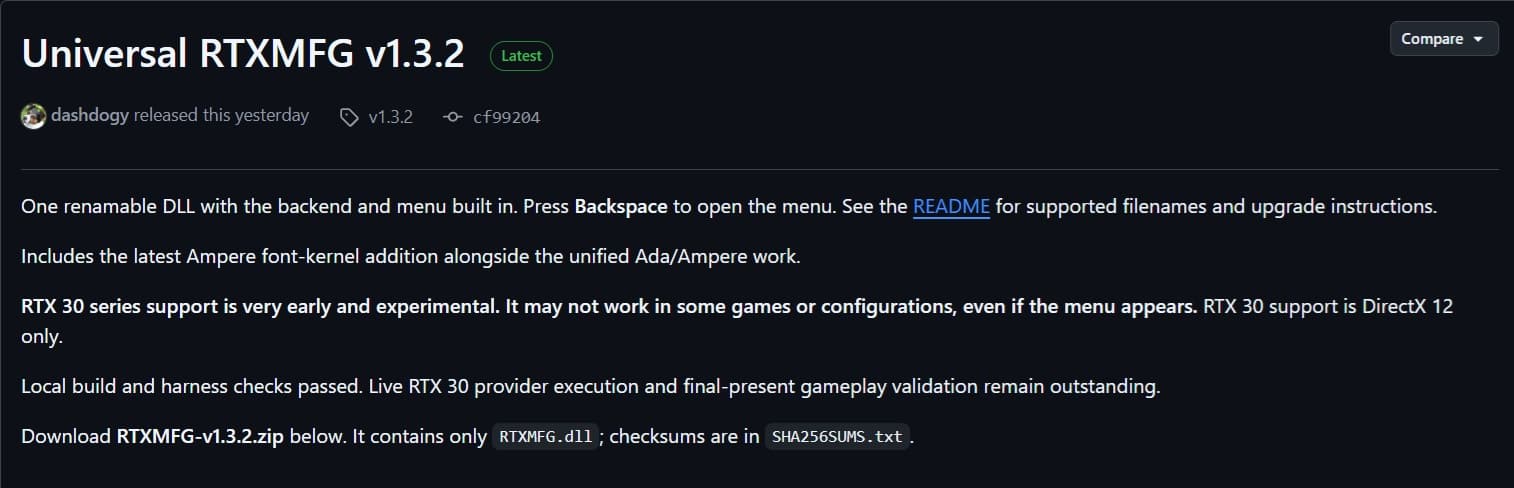
The RTX 40 "Ada Lovelace" Series is perhaps unsurprisingly the furthest along. Dashdogy's RTX40MFG-Unlock has evolved into a universal DirectX 12/Vulkan solution for games that already support DLSS Frame Generation via NVIDIA’s Streamline framework, offering fixed MFG multipliers alongside experimental higher — and even dynamic — MFG modes.
Other projects have taken different approaches. Mavismmg’s MFGAdaUnlock-RenoDx provides a ReShade/RenoDX-based implementation, while matiasLombo's mfg-unlock rebuilds Blackwell-targeted DLSS MFG kernels for Ada.
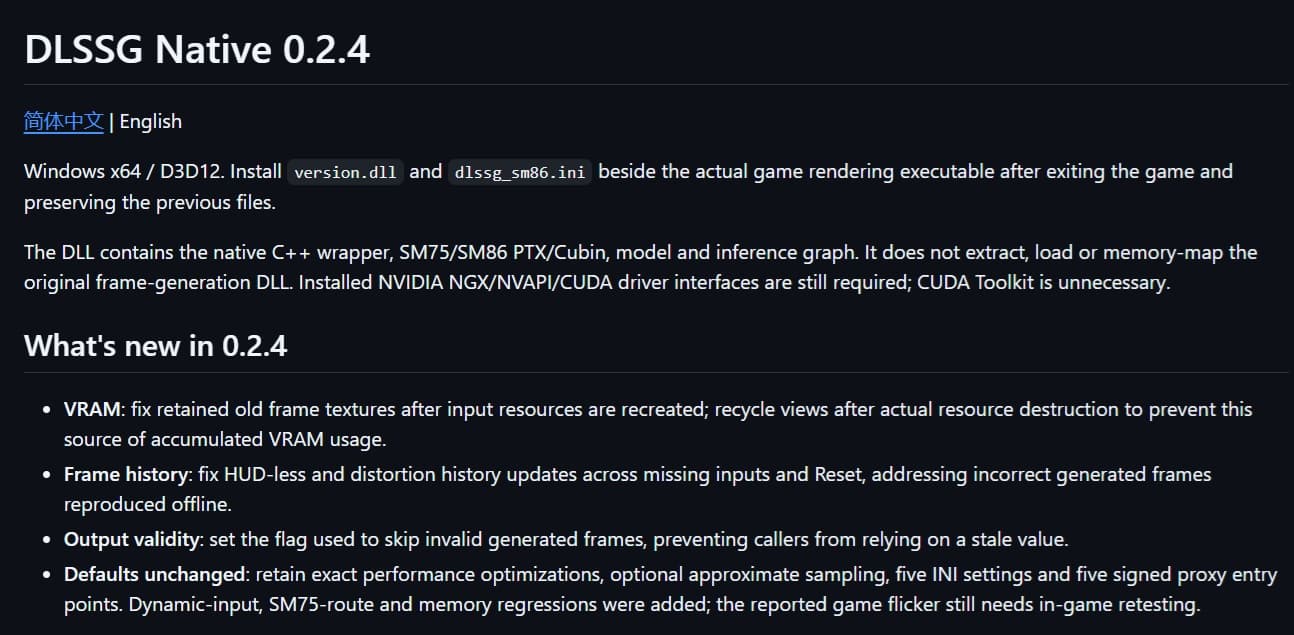
Things recently became much more interesting for RTX 30 "Ampere" Series users. Developer sdli1995's dlssg_for_sm86 implements an SM86 — which denotes the NVIDIA Ampere generation CUDA compute capability — backend for NVIDIA's DLSS MFG runtime, allowing RTX 30 Series GPUs to run DLSS (Multi) Frame Generation, including 2X, 3X, and 4X modes where supported.
The current implementation embeds NVIDIA's DLSS MFG 310.1.X runtime/DLL file alongside its custom SM86 backend and has been tested on an RTX 3080 Ti. Compatibility is far from universal, however, with users already reporting everything from missing FG options to crashes and visual artifacts in certain games.
It seems that even NVIDIA's much older RTX 20 "Turing" Series GPUs have now entered the picture. Coldwood1026's dlssg_for_sm75 adapts the Ampere project for SM75 — the Turing CUDA compute capability — by rebuilding the required DLSS MFG kernels and modifying its architecture checks.
This is much earlier-stage work: the developer has so far verified it on an RTX 2060 Max-Q running The Witcher 3 in DX12, where the game's DLSS Frame Generation option could successfully be enabled. No broad game or GPU compatibility should be assumed yet.
All of these mods remain experimental and could easily break with game, driver, NVIDIA App, or DLSS runtime updates. NVIDIA also retains considerable control over NGX and Streamline's closed-source DLSS MFG plugin. We have already seen an over-the-air (OTA) update to the Streamline and DLSS MFG runtimes temporarily disrupt earlier Ada unlock methods before modders worked around it, so NVIDIA could tighten its drivers or Streamline framework further and potentially render some of these techniques useless in the future.
About the author: Sebastian Castellanos is a data scientist by education and training. He's also deeply passionate about PC gaming hardware and software. He has recently started writing technical articles and guides on Wccftech about PC hardware, games and mods.
Follow Wccftech on Google to get more of our news coverage in your feeds.