Google has launched WeatherNext 2, an improved AI weather forecasting tool.
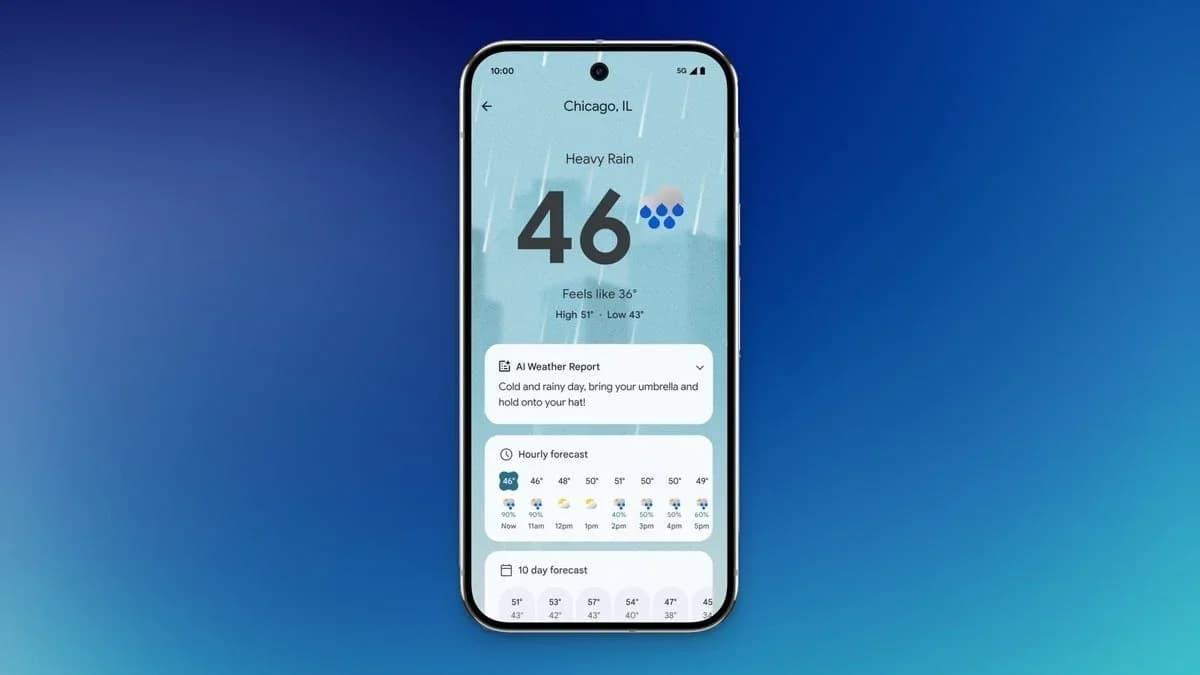
Google's improved AI-based weather forecasting model, WeatherNext 2 s here.
WeatherNext 2 is more accurate than WeatherNext 1 when predicting nearly all variables, including wind speed and direction, temperature, rainfall, pressure, and humidity. Using a Tensor Processing Unit (TPU), a specialized chip created by Google for machine learning and AI, a weather prediction can be generated in under a minute, compared to the hour it would take a supercomputer using physics-based models.
WeatherNext 2 uses a new AI modeling method called a Functional Generative Network (FGN), replacing the Graph Neural Network (GNN) and Conditional Diffusion model used in WeatherNext 1. The older models remain available for reference. WeatherNext 2 is being released to developers, researchers, and other users. It will provide updated weather predictions for the Pixel Weather app (available on the Play Store), the Gemini app for Android, and the Weather API that powers Google Maps.
In the coming weeks, WeatherNext 2 will also manage weather predictions for Google Maps. Any improvements noticed in the forecasts from the Pixel Weather app, Google Maps, and Google Search could be attributed to the enhancements made by Google in the WeatherNext 2 model.
WeatherNext 2 has an improved understanding of the different elements that make up a weather forecast. These elements, like temperature, wind, and pressure, are related, and these relationships can be expressed mathematically. AI weather forecasting does not depend on supercomputers crunching data. Instead, AI identifies patterns that are expected to recur.
WeatherNext 2 can generate 15 days of forecasts in just one minute, allowing for the rapid creation of many forecasts.