Intel Crescent Island GPUs Pack Up To 32 Xe3P Cores, Optimized For Agentic AI With Low-Cost LPDDR5X That Reaches Up To 480 GB Capacity - Wccftech
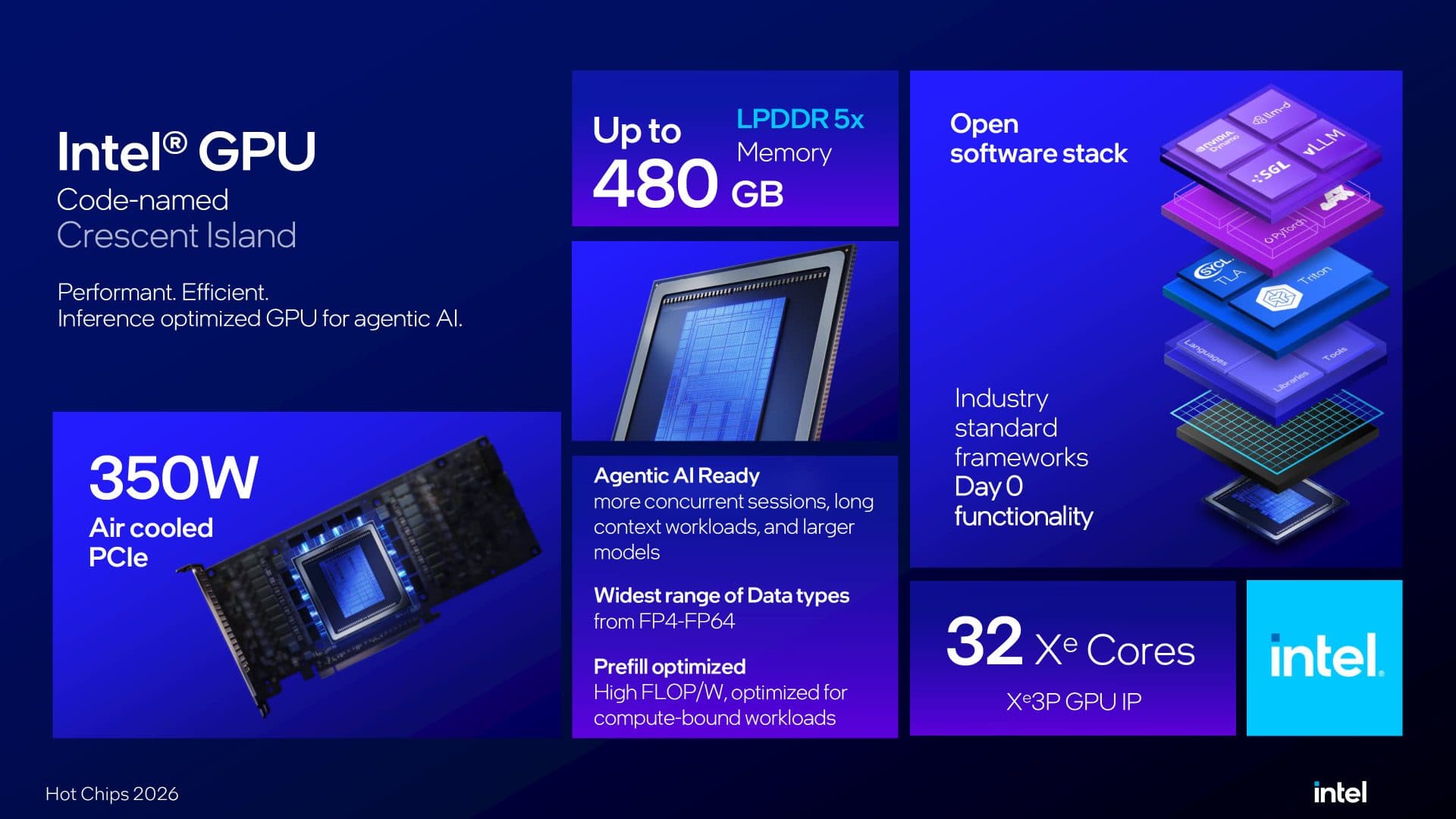
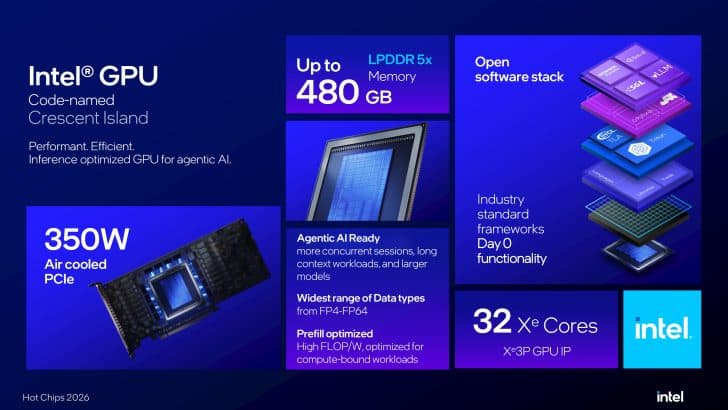



Intel Crescent Island will be both power- and cost-optimized. The Crescent Island GPU is made up of four Compute Slices. This is why Intel is going big with Crescent Island.
Intel has given the rundown on its next-gen AI inference accelerator, Crescent Island, which packs 32 Xe3 cores and 480 GB of LPDDR5X memory.
The Intel Crescent Island GPU is based on the brand-new Xe3P architecture, which is the same graphics architecture that was teased by the company during its Panther Lake and Xe3 deep dives.
The new silicon features of Crescent Island include:
Software innovations for Crescent Island include:
The new GPU architecture will be a further upgrade over the Xe3 architecture, and for clients, the architecture will be featured on the next-gen Arc family, the Arc C-Series. But Xe3P is going to be even more scalable, from client iGPUs to data center AI GPUs.
Intel Crescent Island will be both power- and cost-optimized. It will be targeted at air-cooled data center solutions and workstations and will be aimed at AI inference workloads. According to Intel, the Xe3P graphics architecture used for Crescent Island will be optimized for performance per watt.
Competitors such as NVIDIA and AMD are offering their data center AI solutions with top-grade HBM memory, such as HBM3E, and are already shipping the first HBM4 solutions for next-gen parts such as Rubin and MI450X. But at the same time, sourcing HBM has become difficult due to increased demand, and that has also led to higher prices. Just for comparison:
The Intel Crescent Island GPUs will pack the 3rd Generation Xe architecture codenamed Xe3P. Intel says that this architecture leverages a multigenerational Xe install base with improvements in efficiency and software compatibility. The Crescent Island GPUs leveraging Xe3P are optimized for AI.
On the architectural levels, the 3rd Gen Xe Core "Xe3P" packs 8 Vector Engines and 8 XMX engines per Xe core. The Xe Vector Engine now includes FP8+FP4 Precision, 3-way co-issue, an extended math & FP64 (full rate 64 FMA/XeCore) capability, while the Xe Matrix Extensions (XMX) units offer 16-deep systolic array. There's also 1 MB of GRD per Xe Core.
The Crescent Island GPU is made up of four Compute Slices. Each slice packs 8 cores, so that gives us a total of 32 Xe3P cores, 256 Vector Engines, and 256 XMX units. Each Xe core retains load/store units, a dedicated I$, and L1$/SLM cache. All Compute slices are connected to a large L2 cache.
For the memory subsystem, Intel's Xe3P "Crescent Island" GPU packs 512 KB of L1$/SLM per Xe Core or 16 MB in total, 32 MB of Unified L2 cache, and up to 480 GB of LPDDR5X memory. Intel-branded solutions will feature 160 GB of LPDDR5X memory.
Leveraging LPDDR5X memory can give Intel a big edge in the cost/performance segment. Furthermore, the architecture will support a broad range of data types that are ideal for "Tokens-as-a-service" providers and inference use cases. This is why Intel is going big with Crescent Island.
Starting with the specifications, the Intel Crescent Island Data Center GPU will feature up to 480 GB of LPDDR5X capacity. The reference Intel PCIe card will feature 160 GB of LP5X memory, but partners will be given the freedom to build ODM-branded cards with flexible options up to 480 GB.
The use of LP5X memory also cuts down power significantly, with just 350W of TDP on the air-cooled PCIe version. Intel states that LP5X memory enables a densely packed channel design, which enables a significant bandwidth increase. We have already seen initial PCIe boards with support for up to 160 GB of memory, so the partner board should be even more interesting.
Another thing about Crescent Island is that traditional GPU blocks, such as graphics or 3D support. The chip solely focuses on GPGPU, and that freed more die area for additional AI compute. Plus, the chip is optimized for Perf/Watt and Perf/TCO.
The GPU will be backed by a wide-range data format support from FP4 up to FP64, and will also support a fully Open and Robust software stack.
Intel is already evaluating its open and unified software stack for heterogeneous AI systems with its existing Arc Pro B-series lineup, so future iterations will be able to access these optimizations early on. Intel is currently targeting customer sampling for its Crescent Island GPU for the 2H of 2026, so we'll definitely learn more about the GPU in the coming months.
About the author: A Software Engineer by training and a PC enthusiast by passion, Hassan Mujtaba serves as Wccftech's Senior Editor for hardware section. With years of experience in the industry, he specializes in deep-dive technical analysis of next-generation CPU and GPU architectures, motherboards, and cooling solutions. His work involves not only breaking news on upcoming technologies but also extensive hands-on reviews and benchmarking.
Follow Wccftech on Google to get more of our news coverage in your feeds.