NVIDIA Confirms DLSS 5 Support Extends To RTX 40 GPUs, But First Focusing On Model Optimization on RTX 50 Series - Wccftech


NVIDIA DLSS 5 is going to be released on older RTX 40 GPUs and will be available once the model is fully tuned on RTX 50 series. DLSS 5 is our most computationally demanding model to date. And that fine-tuning starts at RTX 50 GPUs, and then leads into RTX 40 GPUs.
NVIDIA DLSS 5 is going to be released on older RTX 40 GPUs and will be available once the model is fully tuned on RTX 50 series.
This week, NVIDIA finally launches its DLSS 5 technology, with NBA 2K27 being the first game to offer support for 3D-Guided Neural Rendering. While the initial support is aimed at RTX 50 GPUs based on the Blackwell architecture, NVIDIA is confirming that they plan to extend support to RTX 40 GPUs too, based on the Ada Lovelace architecture.
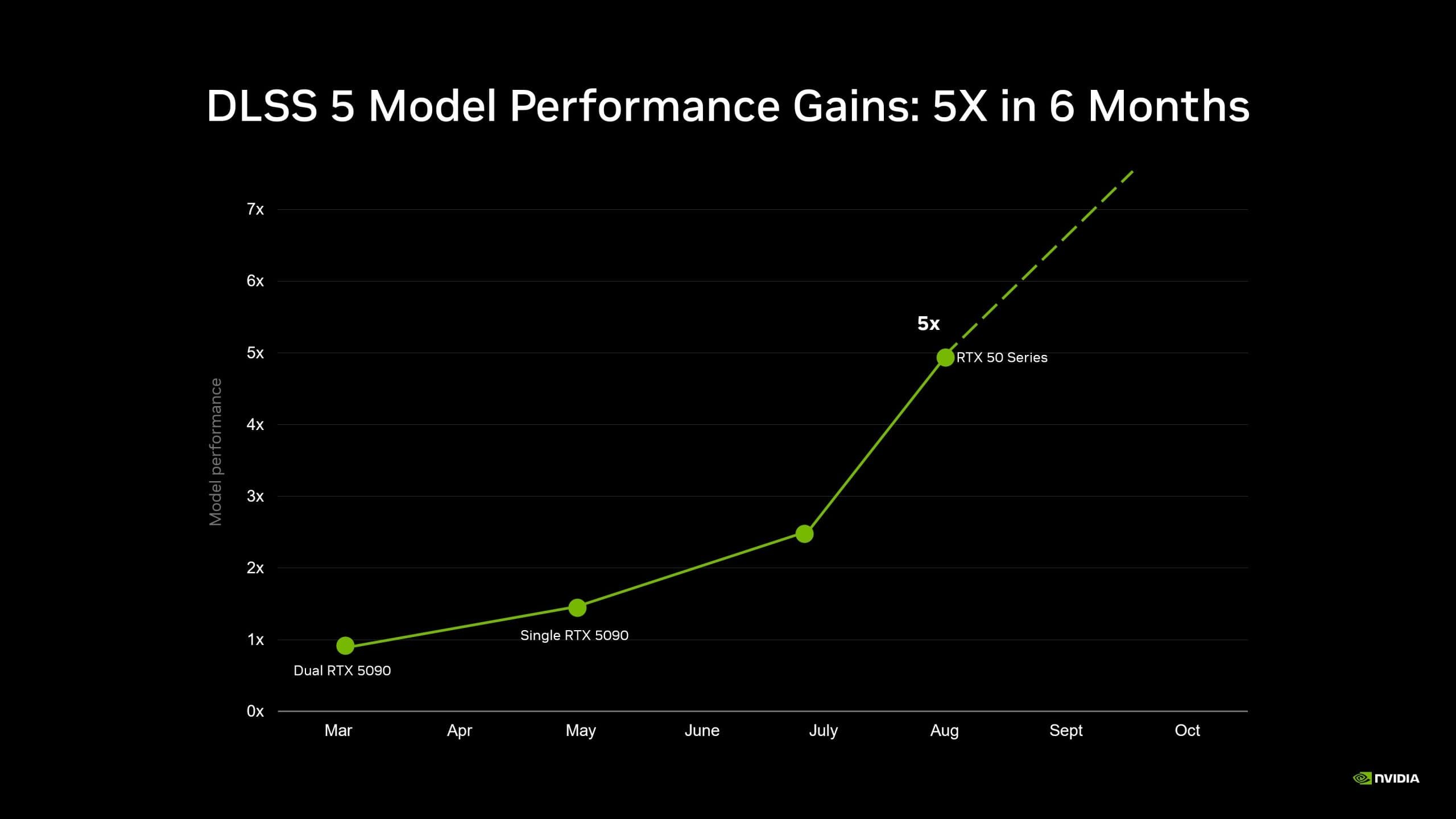
DLSS 5 is our most computationally demanding model to date. Since we initially announced it in March, we’ve achieved a 5X performance gain and there’s more to come.
Our current focus is on optimizing performance for the GeForce RTX 50 Series with model updates expected later this fall. Once RTX 50 Series performance is more fully tuned, we plan to work on expanding official support to the GeForce RTX 40 Series.
The announcement means that more gamers will be able to take advantage of game-changing visuals with DLSS 5 as showcased a few days ago. NVIDIA isn't giving us an exact date for DLSS 5 support on RTX 40 GPUs yet, but they have provided an indication of when that will be possible.
You see, NVIDIA's DLSS 5 is their most demanding AI model to date. The original demo was run on dual RTX 5090 graphics cards, but the company managed to improve the model by 50% within two months, managing to run it on just one RTX 5090.
In July, NVIDIA got the DLSS 5 model to improve by almost 2.5x, and finally, in August, the model improved by 5x and is able to run across all RTX 50 graphics cards. NVIDIA explained that the improvement to the DLSS 5 model is a combination of basic hardware, software kernel, and co-design optimizations. The model is smaller, faster, looks more realistic, and offers more control to developers than the initial model that was presented during GTC 2026.
Furthermore, NVIDIA isn't stopping here. The company says its optimizations for DLSS 5 will roll out at a much faster pace, making the model run faster and look even better. It looks like we'll be able to get another update later this year that improves the model and brings faster performance to the table.
We can expect the optimizations in the coming months to improve the model's performance by 7-10x from its initial unveiling. That would result in far less impact on performance than the existing 50-60% hit on average. If the model ends up having a 10-15% impact on performance by the end of this year, that would make it possible for gamers to run it without using MFG modes such as 6x or with "Performance" mode upscaling.
Since RTX 40 GPUs don't have MFG support, they need the model to get fine-tuned before it can become viable for their hardware. And that fine-tuning starts at RTX 50 GPUs, and then leads into RTX 40 GPUs. Given NVIDIA's history with model tuning, we might even see RTX 30 support down the road since GPUs down to the RTX 20 series are already supporting DLSS 5 through unofficial mods. The RTX 40 support is great news, and we can't wait to see Ada Lovelace owners enjoy the DLSS 5 goodness on their cards.
About the author: A Software Engineer by training and a PC enthusiast by passion, Hassan Mujtaba serves as Wccftech's Senior Editor for hardware section. With years of experience in the industry, he specializes in deep-dive technical analysis of next-generation CPU and GPU architectures, motherboards, and cooling solutions. His work involves not only breaking news on upcoming technologies but also extensive hands-on reviews and benchmarking.
Follow Wccftech on Google to get more of our news coverage in your feeds.