Rumors suggest Apple may release a foldable iPhone in 2026.
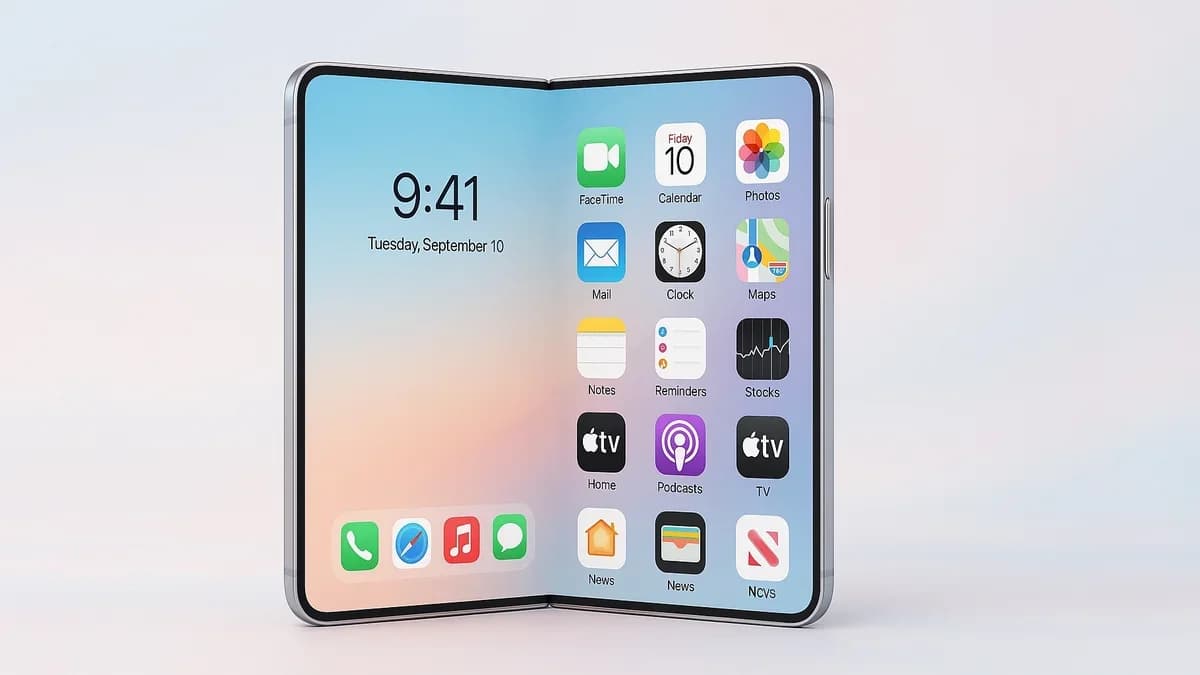
From design to price, here’s a full roundup of what to expect from Apple’s first foldable iPhone.
Initial reports indicate the foldable iPhone may have a thickness of 9 to 9.5mm when folded, which would decrease to about 4.5 to 4.8mm when unfolded. This aligns with current foldable devices, where reducing each millimeter is a key goal.
The inside of Apple’s foldable iPhone is expected to have a sizable 7.8-inch folding screen, while the external cover display will reportedly be around 5.5 inches, similar to the iPhone 13 mini's display.
Notably, both screens are rumored to have wider and shorter aspect ratios compared to other foldables available, which could create a viewing experience more like an iPad, rather than the taller, narrower screens of Samsung's devices.
Regarding cameras, the foldable iPhone is expected to include a dual-lens rear setup, with both lenses at 48 MP, mirroring the standard iPhone 17. It is also expected to feature a front-facing camera for each screen: one for use when the device is closed and another under the internal display for when it is unfolded.
The main screen may feature an under-display selfie camera (USC) to maintain a streamlined look when opened. The cover screen will likely employ a more common punch-hole camera design.
Touch ID could return to the iPhone with the foldable model. Rumors suggest Apple might exclude Face ID and instead opt for a side-mounted Touch ID button to conserve internal space. Given that the company already uses this design on the iPad, iPad Air, and iPad mini, its inclusion in the foldable iPhone would not be surprising.
The device's connectivity could be powered by Apple’s proprietary C2 modem, the second-generation chip intended as a replacement for Qualcomm hardware. The initial C1 modem was introduced with the iPhone 16e, followed by the C1X in the iPhone Air.
The inclusion of the C2 in the foldable iPhone would signify further advancement in Apple’s initiative to manage all aspects of its hardware—from processors to modems.
The foldable iPhone, if launched alongside the iPhone 18 series, is anticipated to use Apple’s A20 chip. While the specific version is unknown, the upgrade appears substantial.
The A20 is rumored to use a 2nm (N2) process, unlike the A19 chip in the iPhone 17 series, which uses a 3nm process. This transition could result in about 15% enhanced performance, along with a 30% decrease in power consumption, representing one of Apple’s more significant chip upgrades.
The foldable device is rumored to have 12 GB of RAM, along with storage options of 256 GB, 512 GB, or 1 TB. These specifications are expected for a flagship foldable device, particularly one that is projected to be expensive.
The foldable iPhone is rumored to be priced at approximately $2,000, positioning it alongside Samsung’s Galaxy Z Fold 7 as one of the most expensive smartphones available.
Finally, the foldable iPhone is rumored to include a battery with a capacity between 5,000mAh and 5,500mAh, which would be the largest battery ever included in an iPhone.
A key question is how Apple intends to integrate such a large battery into a foldable design while preventing the phone from feeling heavy. Given the limited space in foldable devices, it remains to be seen if Apple has developed a new battery technology.
Apple seems to be nearing the introduction of its first foldable iPhone, and more information is likely to emerge over the next few months. Future leaks may offer additional details regarding its design and provide more clarity on Apple's vision for a foldable device.
Currently, Apple appears to be adopting a more conservative strategy with its initial foldable device, opting for a safer and more reliable design rather than pursuing radical innovation.