Samsung's new Galaxy Z TriFold phone features a 10-inch screen and the largest battery in the Galaxy line.
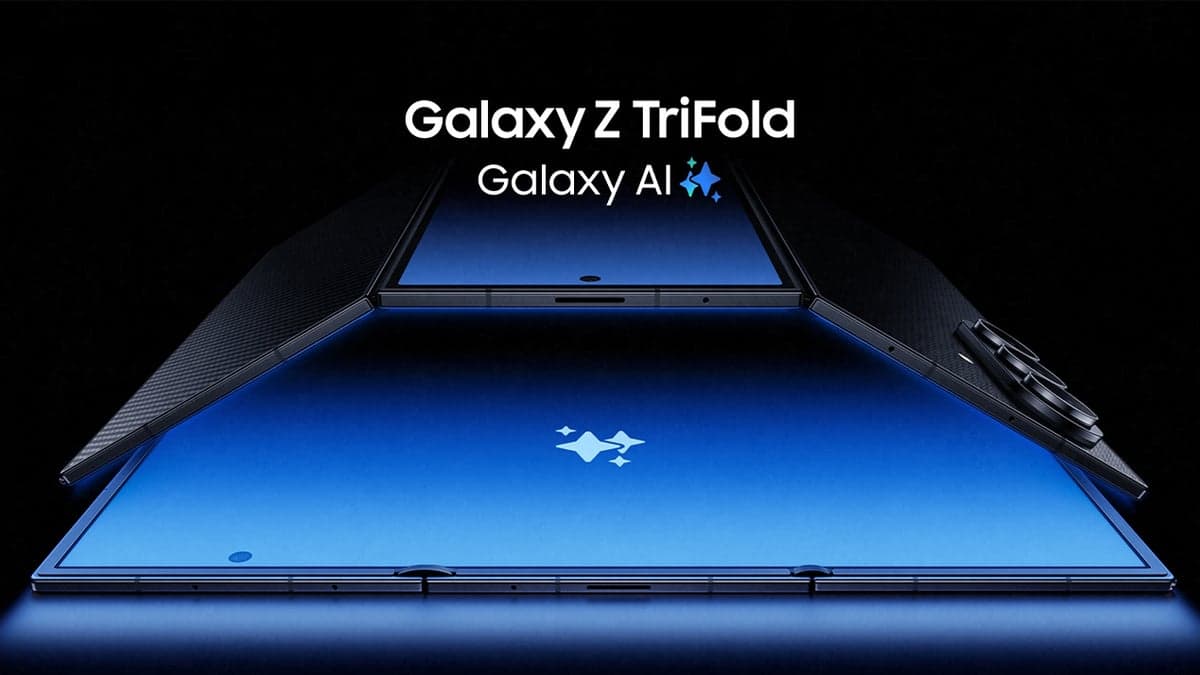
It's no longer just Huawei that has a tri-foldable phone on the market, but can Samsung make the next big step for foldable smartphones?
The Galaxy Z TriFold utilizes a unique inward multi-folding design, safeguarding the main display with a calibrated mechanism that includes an auto-alarm. If an incorrect fold is attempted, the system provides on-screen messages and haptic feedback to ensure correct folding and device integrity.
According to TM Roh, CEO of Samsung's DX Division, the Galaxy Z TriFold balances portability, performance, and productivity, pushing the boundaries of mobile work, creativity, and connection.
The refined Armor FlexHinge system, originating from the Galaxy Z Fold 7 and Z Flip 7, employs two differently sized hinges with a dual-rail structure for smoother folding and a minimized gap when closed.
A titanium hinge housing protects the mechanism, while an Advanced Armor Aluminum frame adds rigidity. Quality checks include CT scans of the flexible circuit board and laser scans to confirm component mounting accuracy.
Unlike Huawei’s Mate XT Ultimate Design, which folds in a "Z" pattern with one main display panel exposed, the Z TriFold folds in a "G" motion, fully protecting the main display when closed and using a separate external display.
Roh stated that Samsung continues to innovate foldable designs, with the Galaxy Z TriFold balancing portability, performance and productivity.
Foldable fans desire large displays and advanced technology. The Galaxy Z TriFold features a 10-inch Dynamic AMOLED main display (2160 x 1584 px, 269 ppi) with 1,600 nits brightness and a 1-120Hz adaptive refresh rate. The 6.5-inch Dynamic AMOLED cover screen has 2520 x 1080 resolution, 422 ppi, 2,600 nits peak brightness, and a 120 Hz refresh rate.
When folded, the Galaxy Z TriFold measures 159.2 x 75.0 x 12.9 mm, and when unfolded, it measures 159.2 x 214.1 x 3.9 mm and weighs 309 g. The Huawei Mate XT Ultimate Design is slightly thinner at 3.6 mm unfolded and weighs 298 g.
The Galaxy Z TriFold has five cameras: a 200 MP wide-angle main camera, a 12 MP ultra-wide, a 10 MP telephoto with 3x optical zoom, a 10 MP cover screen selfie camera, and a 10 MP main screen selfie camera. It is expected to match the Galaxy Z Fold 7’s camera performance, but how will it compare to the S26 Ultra?
The phone uses a Snapdragon 8 Elite chipset, has 16 GB of RAM, and offers either 512 GB or 1 TB of storage. It comes with One UI 8 (Android 16) and a side fingerprint sensor. It is available only in Crafted Black, with a carbon fiber-like material.
The three-cell battery has a 5,600 mAh capacity, supporting 45W wired and 15W wireless charging. The Galaxy S25 Ultra has a 5,000 mAh battery.
The Galaxy Z TriFold is rated IP48 (water-resistant), with Gorilla Glass Ceramic 2 protection and a ceramic-glass fiber reinforced polymer back. The 10-inch display has a restructured design for increased durability.
Targeted at power users and professionals, the Galaxy Z TriFold's 10-inch display can operate with the screen real estate equivalent to three 6.5-inch smartphones simultaneously. It includes a standalone Samsung Dex feature, allowing users to establish a desktop environment without needing a separate display. A keyboard and mouse are all that is needed for a portable mini-PC setup.
Dex can also use an external monitor in Extended Mode for a dual-screen experience. Galaxy AI features are also integrated.
The Huawei Mate XT Ultimate Design has faster 66W wired and 50W wireless charging, a higher pixel density main display (381 PPI), and a longer 5.5x optical zoom.
The Galaxy Z TriFold has a more recent processor, a 200 MP camera sensor, Android, and Dex functionality.
The Galaxy Z TriFold is expected to be available in South Korea on December 12, with availability in China, Taiwan, Singapore, the UAE, and the US to follow. Pricing has yet to be announced.